New: online bookings, e-signatures, email marketing, HR & payroll and WhatsApp Business API.+254 708 08 00 99WhatsApp usLog in:SMS & WhatsAppBilling

Beep Miradi · Programme management for NGOs · Early access

From the field to the donor report, one set of numbers.

Beep Miradi brings your programmes, grants and field teams together: field officers record work on their phones even offline, budgets follow each donor’s lines, and reports are ready when the donor asks, with children’s and health data protected at every step.

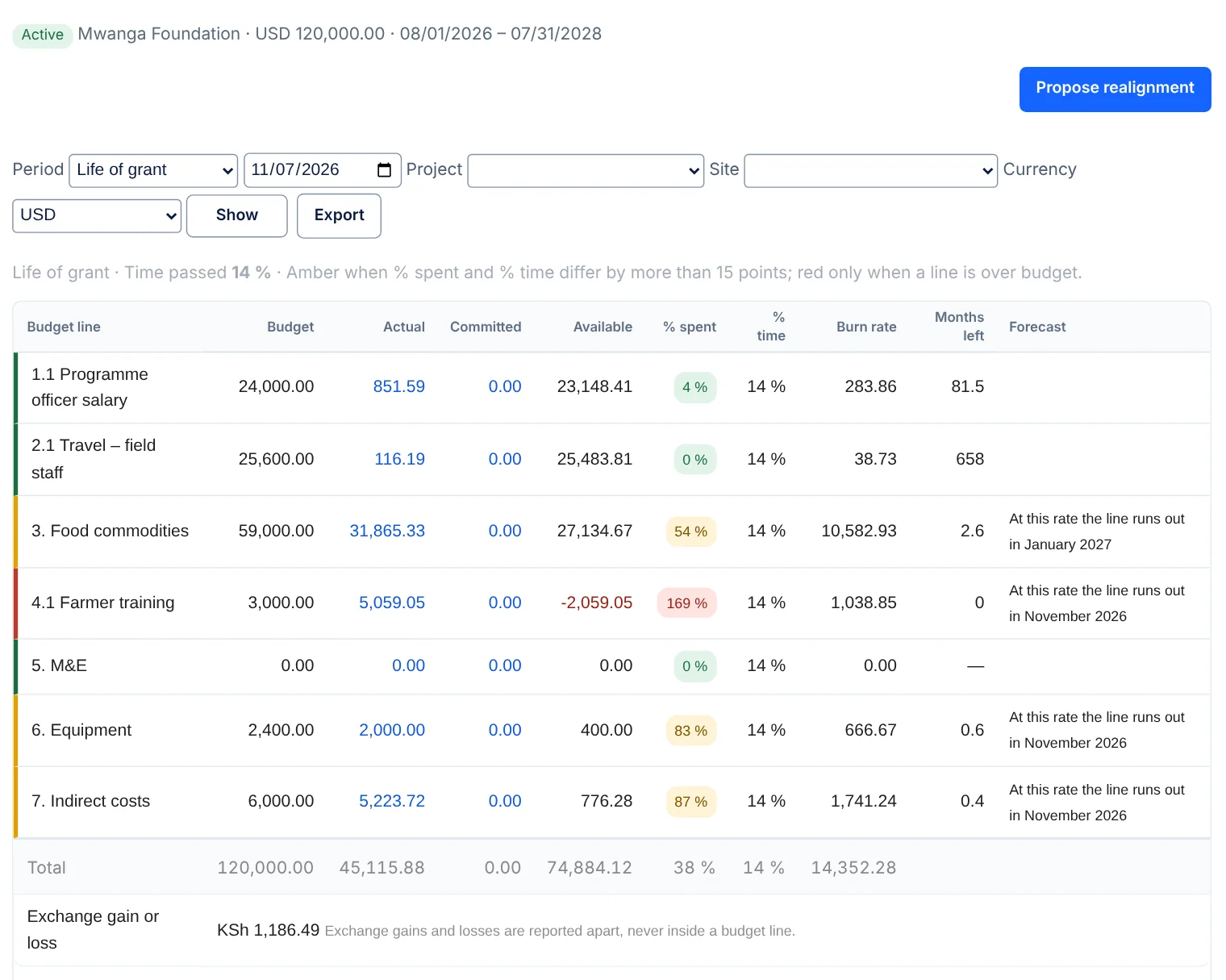
Budget vs actual for a donor grant in Beep Miradi, with burn rate and a forecast of when each line runs out (sample data)
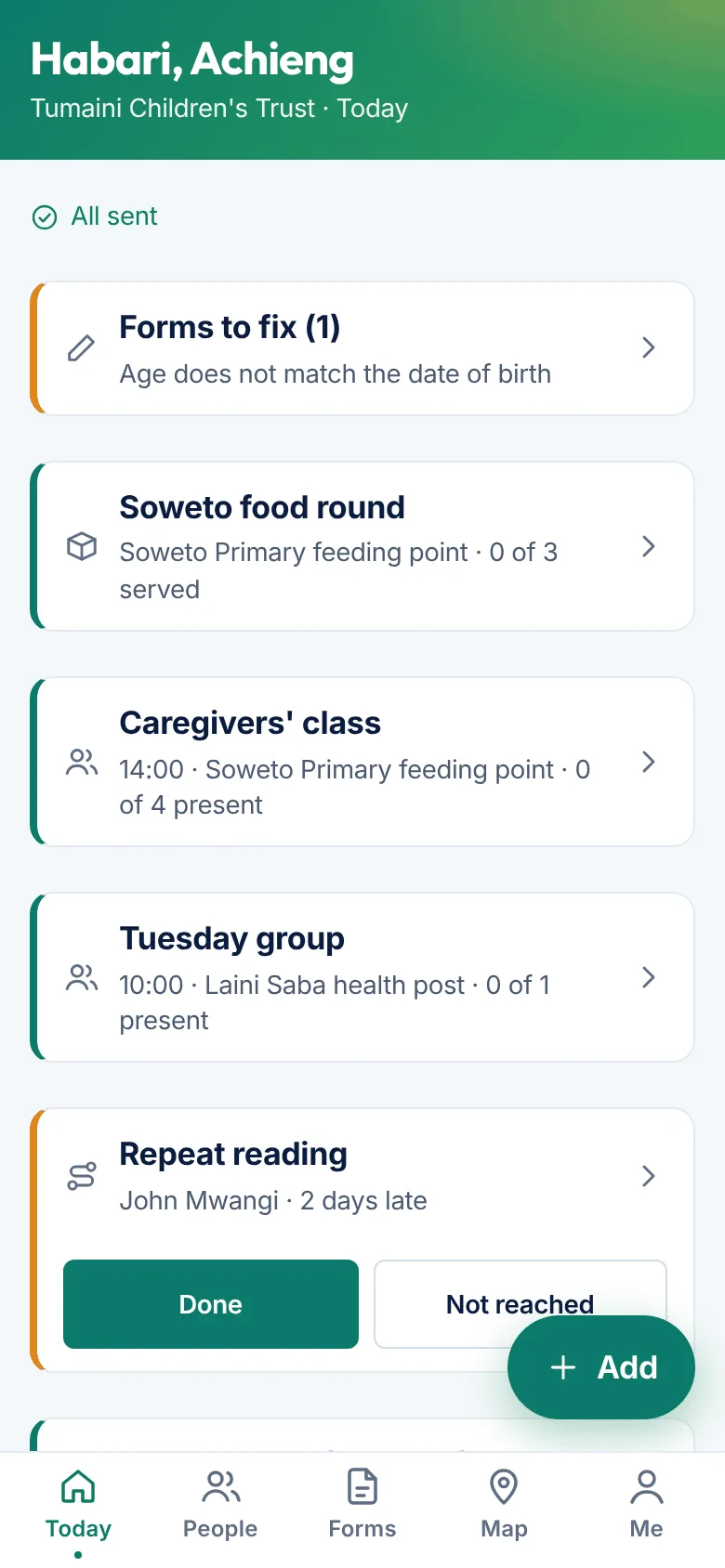
Today list in the Beep Miradi field app: forms to fix, a food round, a class and follow-ups (sample data)
Real screens · sample data · early access

Who it’s for

Built for organisations that serve communities

NGOs

Local NGOs and the country offices of international NGOs, with several donors and many projects.

Community-based organisations

Small teams that need donor-ready records without a full-time systems officer.

Faith-based organisations

Church ministries and faith-based programmes, from feeding to HIV care.

Foundations & trusts

Grant makers that track their own programmes and the partners they fund.

Children’s homes

Homes moving to family-based care, with care plans and reintegration follow-ups.

Partners & sub-grantees

Partners will report through their own portal, and never see each other’s data.

Grants & budgets

Every shilling on the right donor line

Each grant keeps the donor’s own budget lines, currency and rules. Expenses, supplier invoices, payroll and field advances are charged to a line as they happen, so budget vs actual and the burn rate are always up to date.
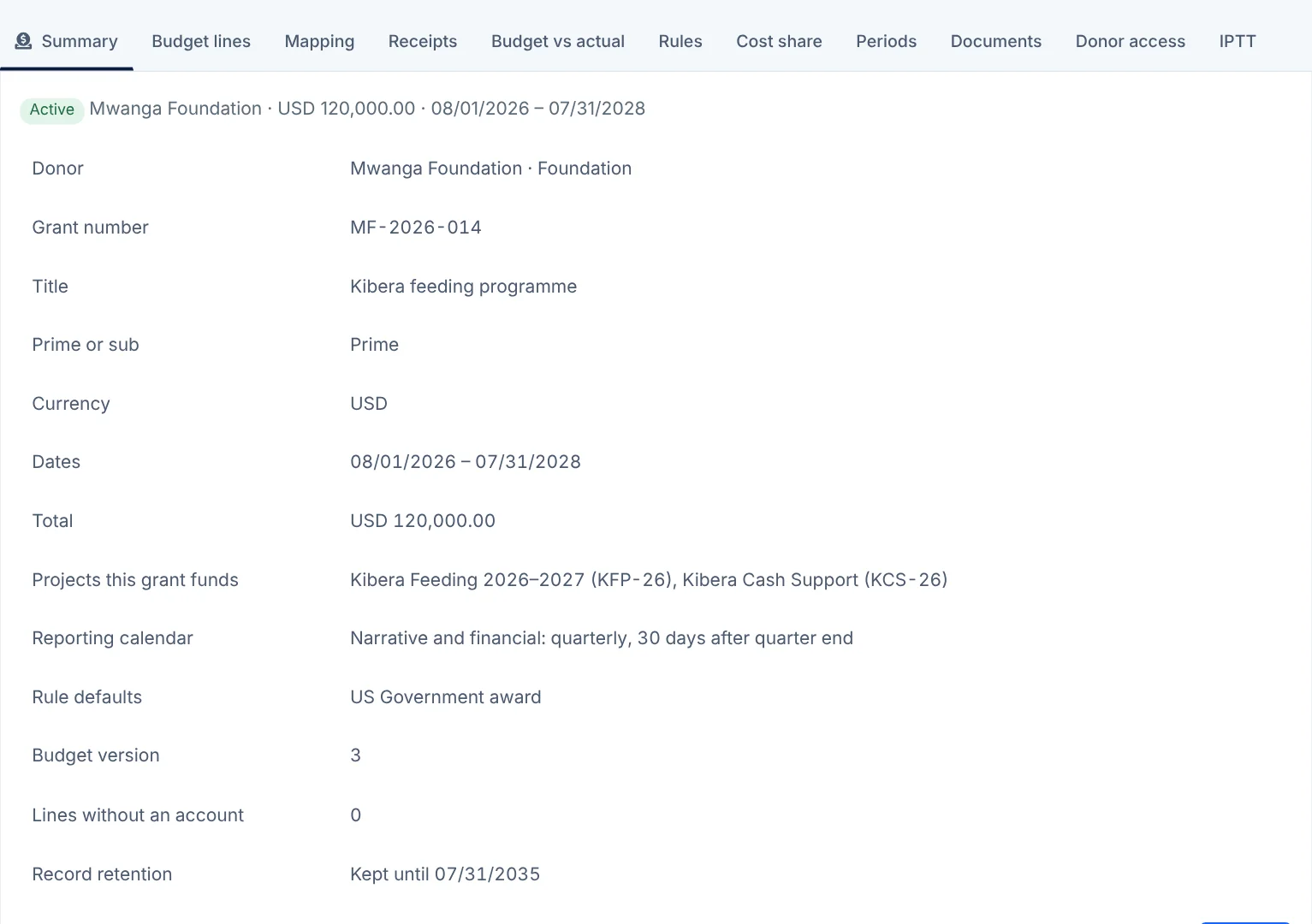
A donor grant in Beep Miradi: donor, budget version, projects it funds, reporting calendar and cash position (sample data)
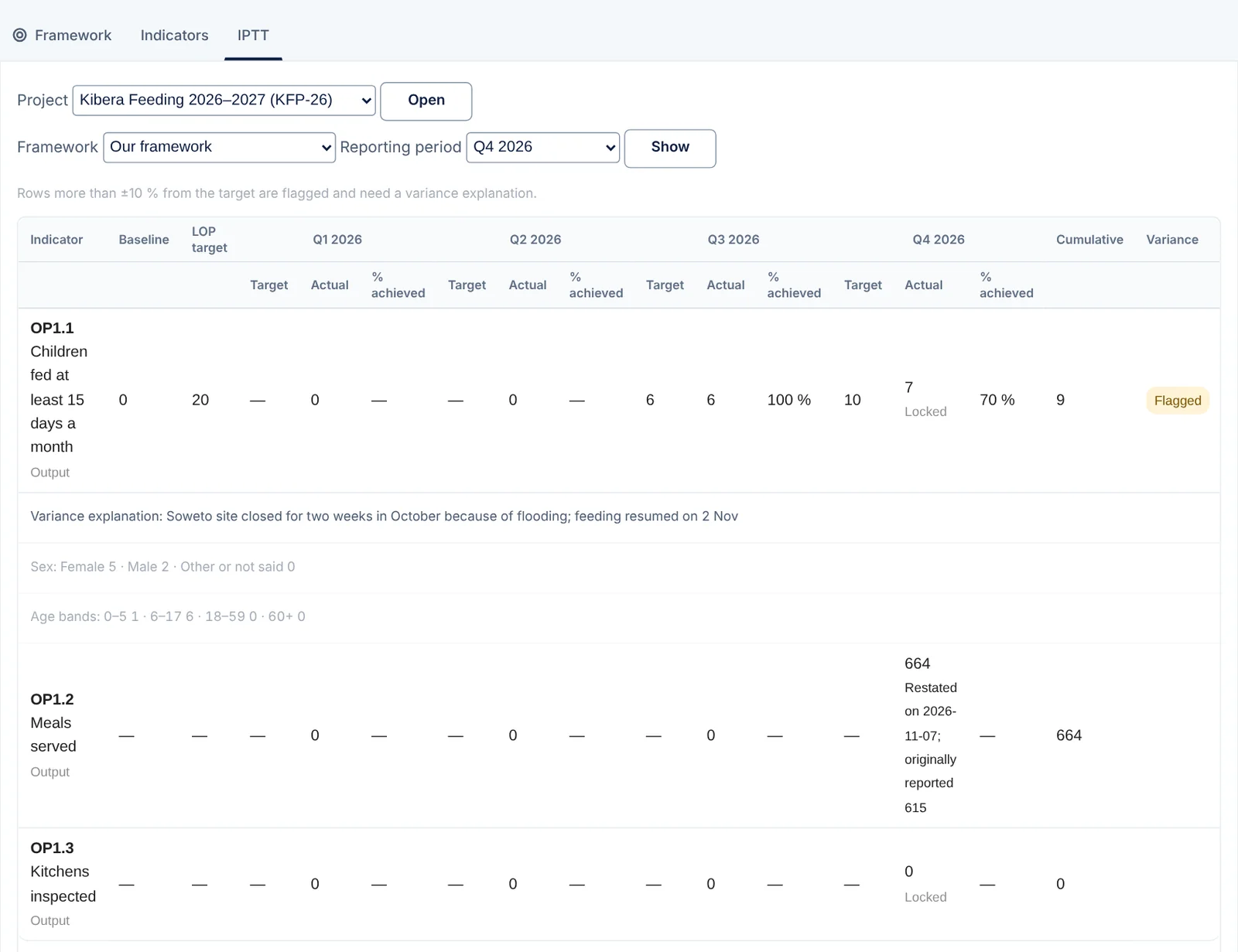
Indicator tracking table with targets, actuals, % achieved and a variance explanation (sample data)
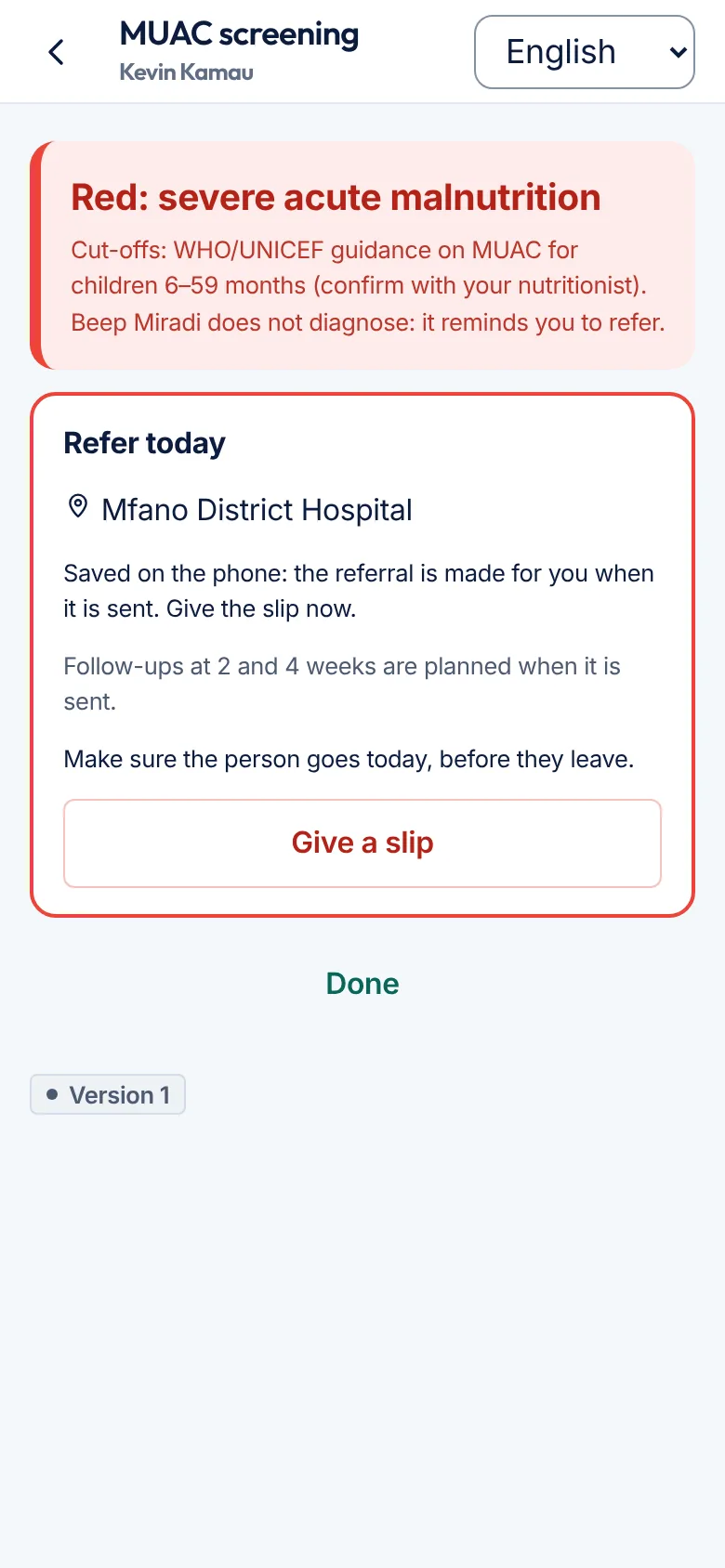
MUAC screening in the field app: a red result with a referral to make today (sample data)

Results

Your results framework and the IPTT, from the field

Build your logframe or theory of change once and map each donor’s framework to it. Every form, distribution and screening recorded in the field counts towards its indicator, broken down by sex and age.

Field work & cash

Field officers work offline. Cash goes only to the right people.

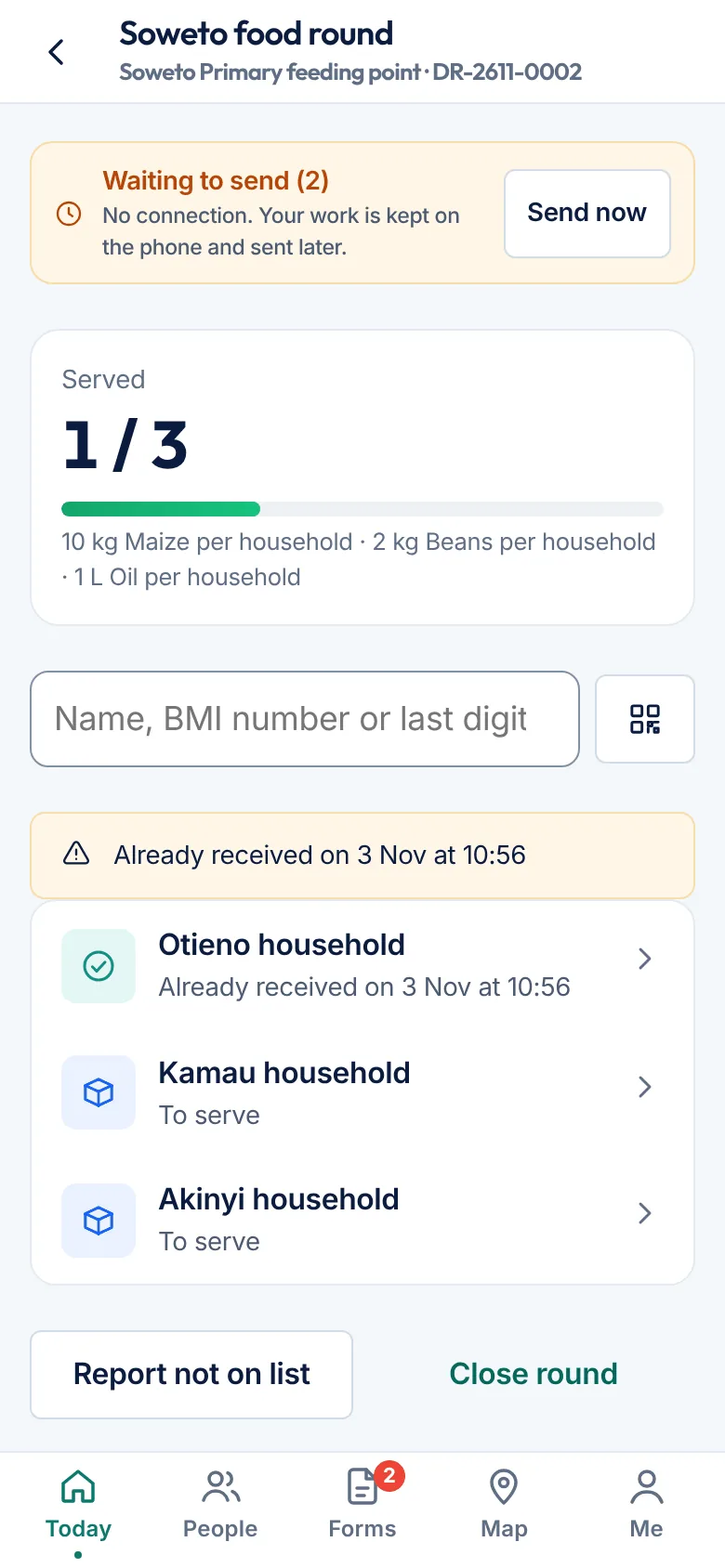
The field app holds today’s visits, distributions and follow-ups, and sends everything when there’s network. Cash transfers go by M-PESA only to registered, verified numbers, after two different people approve.
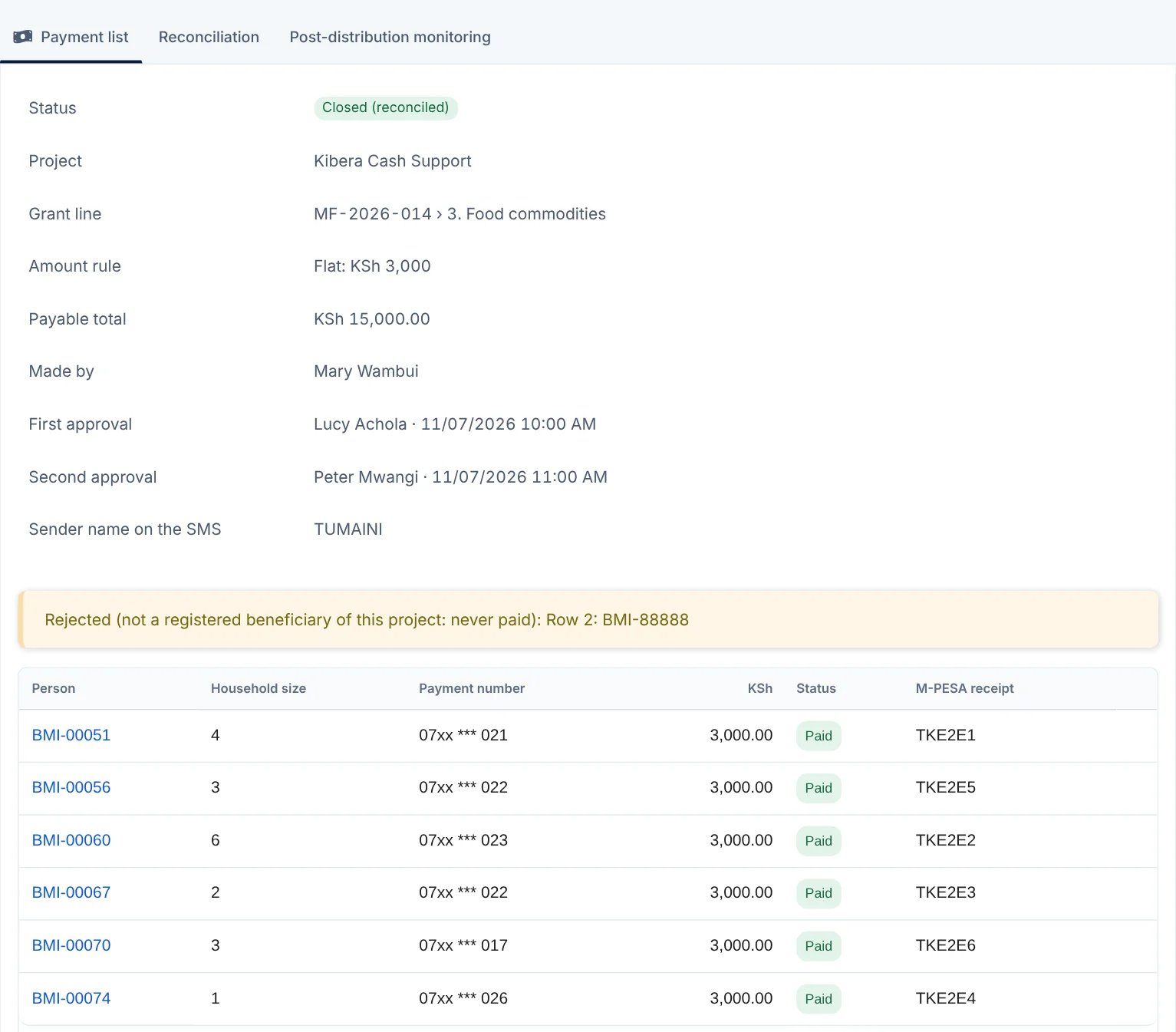
A closed cash transfer round: two approvals, masked phone numbers and M-PESA receipts (sample data)
A food distribution round in the field app, recorded offline (sample data)
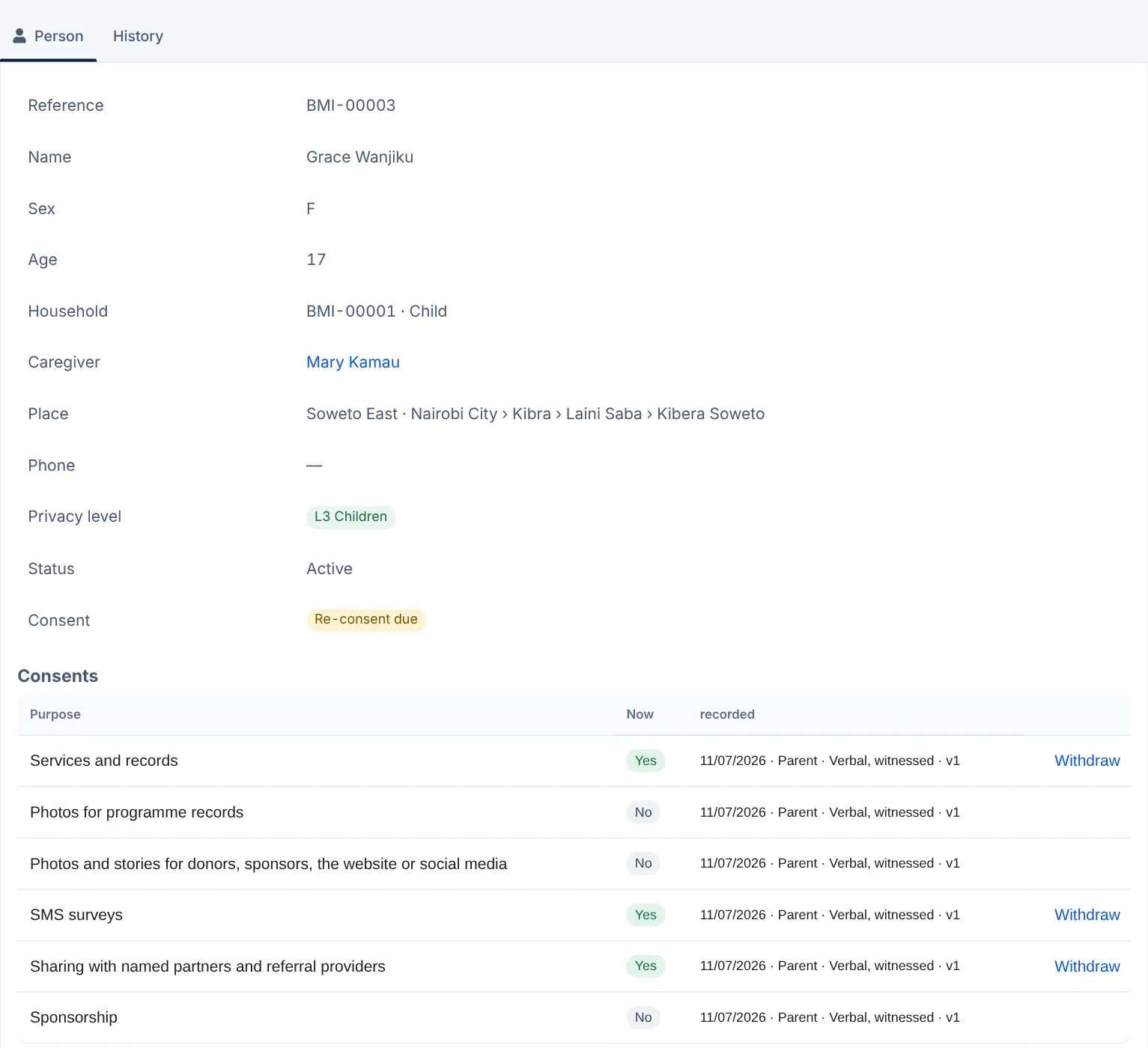
A person’s record with privacy level, consent per purpose, services and follow-ups (sample data)

Beneficiary register

People recorded with consent, seen only by those who work with them

Households and individuals get a reference number, a privacy level and consent recorded for each purpose. Phone numbers are masked, and the most sensitive records show codes instead of names.

Donor reports

A donor report in an afternoon, not a fortnight

Budget vs actual by donor line, the indicator tracking table and stories shared with consent come straight from the work your team already recorded. Works to donor standards such as US government grants, FCDO, EU, Global Fund and UN agencies.
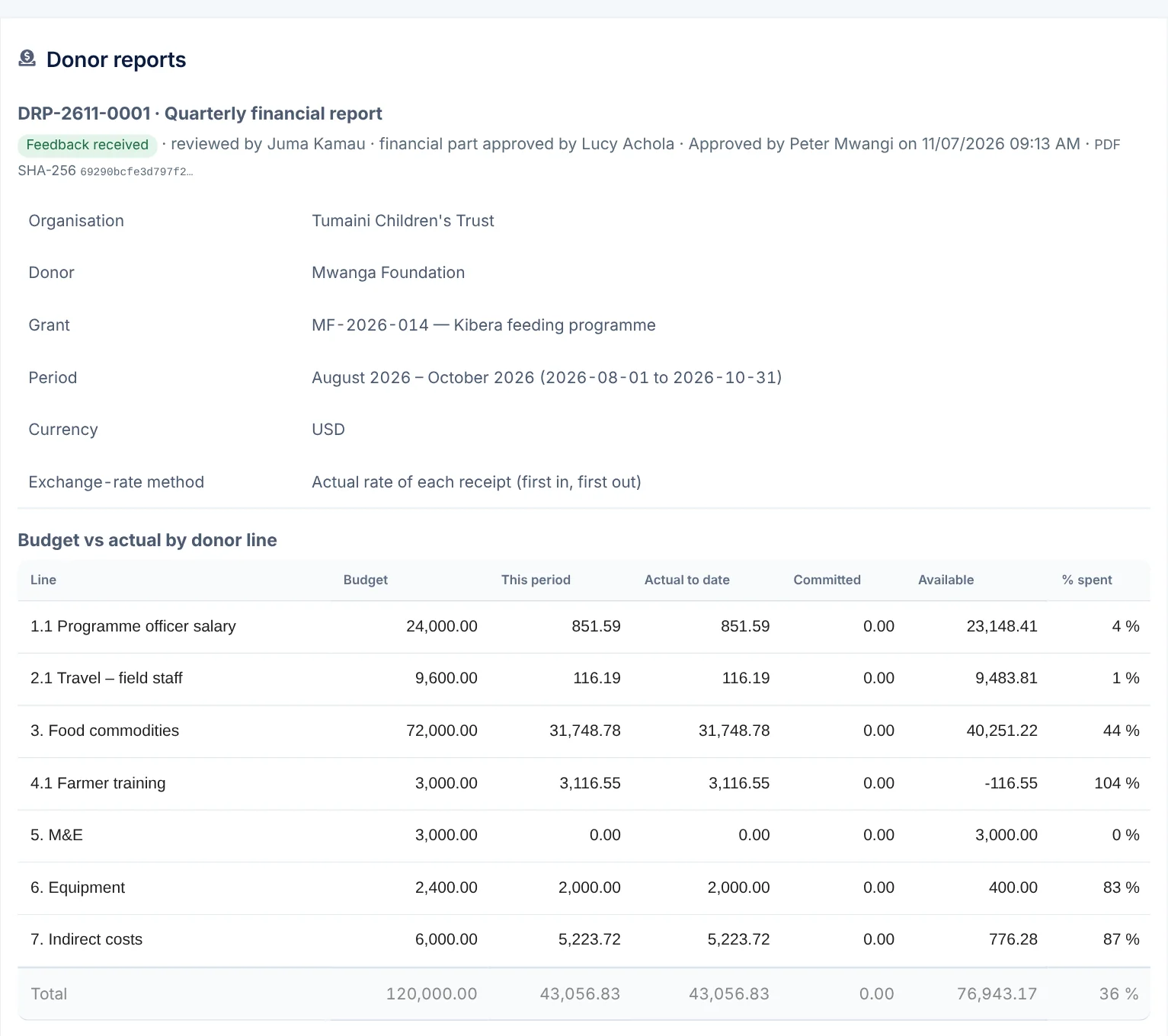
A quarterly financial report for a donor, with budget vs actual by donor line (sample data)

The core

Also in Beep Miradi

Miradi is Kiswahili for “projects”. A distribution recorded in the field, the stock it used, the money it cost, the donor line it is charged to and the indicator it counts towards are linked, not kept in four spreadsheets.

Programmes & work plansProgrammes, projects, activities and timelines, with who does what and by when.
Audit-readyEvidence on every budget line, field advances and their liquidation, and a log nobody can edit.
Feedback & safeguardingComplaints by SMS, phone or in person, with safeguarding cases sealed to your focal person.

Sector packs

30 ready-made packs for the work you do

A pack is a set of forms, indicators and a report template for one kind of programme, in English and Kiswahili. All 30 are included: switch on the packs you need for each project and change any form to fit. Each pack has a privacy level, and the most sensitive records are seen only by the people who work with that person.

Children & education6 packs
  • Children & sponsorshipChildren in slums and street-connected children; sponsor payments made elsewhere and thank-you letters.🔒 Cases: case team only
  • Education supportBursaries, school attendance and results, with a consented link to Beep School.
  • Children’s homes & care reformCare plans, family tracing, reintegration follow-ups and inspection records.🔒 Case team only
  • Orphans & vulnerable childrenHousehold support plans, case worker visits and graduation.🔒 HIV parts as codes
  • Girls’ education & menstrual hygienePads per school per term, attendance and mentorship clubs.🔒 School totals only
  • Youth skills & jobsTraining, certificates, placements and start-up kits, with tracer surveys at 3, 6 and 12 months.
Health & nutrition7 packs
  • Feeding & nutritionFeeding sites, rations and stock, MUAC screening and referrals.
  • Health outreachCamps and household visits with community health promoters, and referrals to facilities.
  • HIV care, diabetes & blood pressureLinkage to care, adherence visits and support groups; community screening and follow-up readings.🔒 Client codes, never in SMS
  • Maternal & newborn healthAntenatal reminders in neutral words, birth plans, referrals and growth monitoring.
  • Malaria & TBNets per household, cough screening and referral, and support to finish treatment.
  • Mental health & psychosocial supportScreening, individual and group sessions and referrals to specialised care.🔒 Urgent supervisor alert on a risk answer
  • Drugs & substance useOutreach, screening, rehab referrals and follow-ups at 30, 90 and 180 days.
Livelihoods & resilience8 packs
  • Rural farmingFarmers, groups and plots, inputs and e-vouchers, trainings and harvests.
  • Cash transfersM-PESA to registered numbers only, two approvals, then checks that people got the full amount.
  • Savings groups (VSLA & table banking)Groups formed and trained, monitoring visits and the share-out at the end of each cycle.
  • Livestock & pastoralistsHerd records, animal health campaigns, fodder and market links.
  • Drought response (ASAL)Targeting, verified food and cash distributions, water trucking and restocking.
  • Floods & disastersRapid needs assessments, relief kits, evacuation sites and a 72-hour situation report.
  • Water & sanitation (WASH)Water points on a map, functionality checks and water tests, repair tickets, latrines and school handwashing.
  • Climate & environmentTrees with GPS and survival checks, cookstoves and solar kits in use, and activity data with evidence.
Protection & rights7 packs
  • GBV survivor case managementIntake with consent, safe referrals the survivor agrees to, a safety plan and case notes. No AI.🔒 Survivor codes, case team only
  • FGM & child-marriage preventionCommunity dialogues, champions, alternative rites of passage and rescues back to school.🔒 Rescues as codes, case team only
  • WidowsLivelihoods, savings groups, psychosocial support and legal aid referrals.
  • Persons with disabilitiesFunctional needs, assistive devices with fitting and repairs, and inclusion in other programmes.
  • Refugees & host communitiesThe IDs people already have, matched not replaced; every result split by refugee and host.🔒 Names shared only under an agreement
  • Older personsHome visits, needs assessments and links to Inua Jamii 70+ and health services.
  • Ex-offender reintegrationPreparation before release, family reunification, livelihood support and follow-ups.
Community & governance2 packs
  • Peacebuilding & early warningEarly-warning reports at ward level, peace committees and dialogue forums.🔒 Names in incidents: case team only
  • Governance & civic educationCounty budget monitoring with photos, public participation forums and citizen scorecards.
Your own programme

Copy any pack and change its forms, or bring your own Kobo or ODK forms.

Shared tools

Built once, used across the packs

Water points & repair ticketsEvery breakdown becomes a ticket with a deadline: reported, assigned, fixed and verified. Communities report by SMS keyword, and the sender’s number stays hidden.
Urgent supervisor alertA risk answer in a mental health or substance use screening, or a high-severity early warning, alerts the supervisor at once.
Information-sharing agreementsTotals or named fields go to a partner only under a recorded agreement, approved by your data protection officer and director.
Share-out calculatorWorks out each member’s share at the end of a savings group’s cycle, with the group. The group’s money and book stay with the group.

Coming later: sending totals to KHIS/DHIS2 (export to Excel for now), USSD surveys and reports (SMS replies, calls and visits for now), publishing to IATI, and reading the drought early-warning bulletin automatically.

Intelligent, never in charge

Help that spots problems early

Beep Miradi raises flags and drafts; your team decides. Nothing rejects a submission, penalises a field officer or removes a beneficiary on its own. Some of these arrive after the first release, in the order our pilot NGOs need them.

Spots suspicious field data

Forms filled too fast, many households at one GPS point, repeated photos or one phone on several people. Each flag comes with its reasons, for your M&E team to check.

Warns before a budget line runs out

“At this rate, Travel runs out in February.” It warns about under-spending too, before the donor asks for money back.

Forecasts your targets

“At the current pace you will reach 82% of the annual target; 3 sites are behind.” Simple, explained projections.

Tells you when the donor must approve a change

Moving money between budget lines? It checks the rules you set from your grant agreement and drafts the request letter with the revised budget.

Report drafts from your real numbers

AI drafts the words around figures the system worked out. It never invents a number, and a person approves every word.

SMS surveys

Short surveys by SMS to people who agreed to them (USSD later), such as checking that a cash transfer arrived in full, with the cost shown before sending.

A map of your work

Sites, water points, plots and distributions on a map. Households show as areas, not exact homes.

A live view for your donor

Read-only indicator and budget totals for the grants you choose to share, and you see who looked at what.

Forms in many languages

English and Kiswahili, plus local languages you add, with audio questions for people who don’t read.

UPENDOnow
Hello Achieng, a reminder about your visit on Fri 6 Nov. Upendo CBO
You have received KSh 3,000 from UPENDO.
Neutral words only: no programme or health terms in any text message

Data protection

Children’s and health information, protected at every step

Beep Miradi is built for the most sensitive information an organisation can hold. What each person can see is decided by the system, not only by training.

Works with Beep

One system from the field to the accounts

Beep Miradi runs in your organisation’s own Beep office system, next to your accounts, payroll and payments, so nothing is typed twice.

Accounts & purchasingEvery expense, supplier invoice and purchase charged to a grant line in your office system.
HR & PayrollStaff costs split across grants by the time people really worked.
M-PESACash transfers and field advances from your own shortcode, with two approvals.
SMS & USSDReminders, short surveys and feedback lines, with neutral sender names.Beep SchoolBursary learners’ fees and attendance, with the family’s consent.Beep AIReport drafts and translations, checked by your team before anything goes out.Beep ChamaSavings groups keep their own books and share totals with you.
DocumentsGrant agreements, evidence and reports, shared with auditors for a limited time.

Pricing

Pricing per organisation.Prices aren’t published yet: ask for early access and we’ll share them with you. There will also be an NGO edition: your accounts, payroll and HR and Beep Miradi together, at its own price. SMS, USSD and AI are used at Beep’s normal rates, and M-PESA charges are Safaricom’s.Ask for early access →

How it works

How to start

1Tell us about your programmes

Your projects, donors and where you work. We set up your organisation with you.

2Add your grants and donor budgets

Each grant with its budget lines, linked to your accounts.

3Bring your forms and beneficiaries

Import your Kobo or ODK forms (XLSForm) and beneficiary lists from Excel.

4Your field officers install the app and go

They work offline and send everything when there’s network.

FAQ

Beep Miradi questions

Beep Africa support agent ready to helpOnline now · 24/7
Talk to a real person

Our Nairobi team answers calls, WhatsApp and email day and night.

Call us+254 708 08 00 99WhatsAppChat with our teamContactSend us a message

Early access: Beep Miradi is being built with pilot NGOs, and we’re onboarding a small number of organisations while it is completed. Join early access and we’ll set it up with you.

Yes. The field app works offline: forms, registrations, distributions and follow-ups are kept encrypted on the phone and sent when there’s network. Payments and approvals always need the network.

Yes. Import XLSForm files (.xlsx). If a form uses something we don’t support, the import tells you exactly what, and we never publish a form whose logic would quietly change. You can export your forms as XLSForm too.

It works to donor standards such as US government grants, FCDO, EU, Global Fund and UN agencies, and to simpler formats for foundations and churches. Templates can be changed for each donor. Beep Miradi is not affiliated with or endorsed by any donor, and your grant agreement always decides.

Children’s and health records are seen only by the people who work with that child or client, and the system enforces it. HIV and GBV records use codes instead of names, and words like HIV never appear in a text message or notification. Photos are reviewed before they leave your team, and a lost phone can be wiped remotely.

Only what you choose to share. A donor gets a read-only view of their own grants, with totals only for sensitive programmes and never a list of names. You can see every view.

Yes, in the release after the first one. Each sub-grantee gets its own partner portal for its budget, reports and advances, and never sees other partners’ data.

Pricing is per organisation. Prices aren’t published yet: ask for early access and we’ll share them with you. An NGO edition, with your accounts, payroll and HR and Beep Miradi together at its own price, will be available too: ask for early access.

No. Beep Miradi doesn’t take card or online payments from sponsors. You record sponsor payments received elsewhere, for example from sponsors abroad, and Beep Miradi sends the thank-you letters and keeps each child’s sponsorship record. Sponsors only ever see approved updates, letters and photos, never a surname, school or address.

Talk to a human

Spend less time on reports and more time with the people you serve.

Request early access and we’ll set up your programmes, grants and field app with you.

Privacy Overview

This website uses cookies so that we can provide you with the best user experience possible. Cookie information is stored in your browser and performs functions such as recognising you when you return to our website and helping our team to understand which sections of the website you find most interesting and useful.